

Staying Relevant as a Leader in a Changing Tech Landscape (Week 8)
Engineering Leadership Foundations Weekly


“The illiterate of the 21st century will not be those who cannot read and write,
but those who cannot learn, unlearn, and relearn.”
— Alvin TofflerAlvin Toffler was a futurist and writer known for predicting how rapid technological and societal changes would reshape the way people work, learn, and lead. His ideas on adaptability and continuous learning remain foundational in today’s fast-moving tech world.
Technology does not move in a straight line. It moves in waves — sometimes gentle, sometimes intense — and each wave brings new tools, new expectations, and new patterns of working. For leaders, this constant evolution can feel overwhelming, because you are not only trying to understand the changes yourself but also guiding a team through them. The pressure to “keep up” becomes a quiet background noise.
But the truth is simpler. Staying relevant as a leader is not about mastering every new technology. It is about staying open, curious, and willing to learn, even when the landscape feels unfamiliar. Curiosity, not expertise, is the real foundation of long-term leadership relevance.
The Drift Happens Slowly
Many leaders fall into the trap of becoming less connected to the craft after taking on managerial responsibilities. It is rarely intentional. Your schedule fills with planning, coordination, hiring, escalations, and cross-team negotiations. You spend more time listening and influencing, and less time building and exploring.
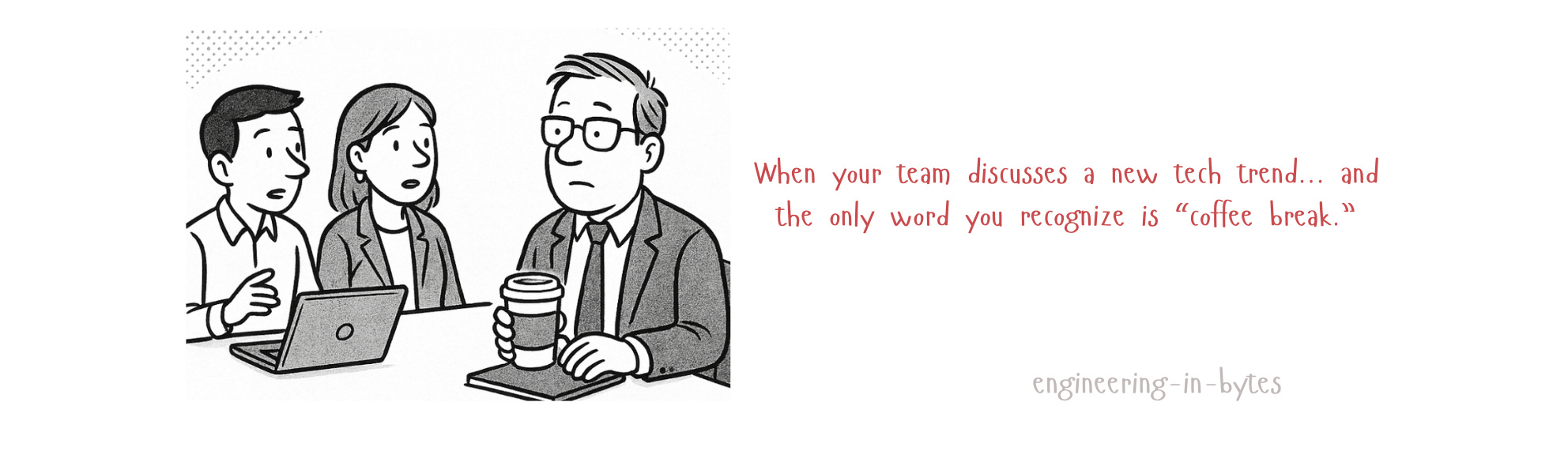
Over time, this shift creates a quiet distance between you and the technical details your team works with every day. You start depending more on others to explain new trends. You become less confident in design discussions or technical debates. And eventually, you may hesitate to dive into topics that once felt natural. This drift doesn’t happen in a single moment — it happens gradually, conversation by conversation.
What matters is recognizing the drift early. Staying relevant is not about going back to being the best engineer in the room. It is about keeping your understanding fresh enough to make good decisions, ask strong questions, and support your team with clarity.
Why Curiosity Matters More Than Mastery
You will never know everything. And you don’t need to. What keeps a leader relevant is the habit of asking questions that get to the heart of the issue. When you stay curious, you focus less on having the right answers and more on understanding the right problems.
Curious leaders make learning visible. They ask how something works without worrying about looking inexperienced. They ask why a new approach matters now. They ask about trade-offs and risks. When a leader shows curiosity openly, the team feels free to do the same. This creates a culture where learning is normal, not a sign of weakness.
In fast-changing environments, mastery has a short shelf life. Curiosity does not. Curiosity is what lets you adjust, reinterpret, and guide your team through unfamiliar territory with confidence.
Recognizing When Your Relevance Is Slipping
There are quiet signals that appear long before a leader realizes they are falling behind. You might avoid reviewing technical designs because they feel dense or unfamiliar. You might rely heavily on your team’s recommendations because you no longer feel able to challenge or validate them. You might notice that people stop seeking your opinion on complex engineering choices.
These moments are not failures. They are reminders. They show you where to lean in and where to refresh your understanding. They also highlight an important truth: relevance is not lost suddenly — it fades slowly when leaders stop engaging with the work that shapes their team’s future.
Noticing these signals early gives you room to course-correct. And the sooner you act, the easier it is to rebuild confidence and connection with the technology your team handles every day.
How Modern Leaders Stay Sharp
Leaders who stay relevant do a few simple things consistently. They learn in public, without needing to appear perfect. They ask their teams to walk them through decisions, architectures, and new frameworks. They listen deeply and encourage explanations without rushing through them.
They also make time — even if it is only an hour a week — to stay hands-on in small ways. They explore a tool, try a new API, review a pull request, or experiment with a workflow. These tiny touchpoints keep their technical instincts alive. They may not write production code anymore, but they remain close enough to understand the work.
Most importantly, they focus on understanding patterns rather than memorizing tools. When you recognize the underlying pattern — streaming over batch, serverless over hosted, event-driven over synchronous — new technologies stop feeling like surprises. They look like natural evolutions.
The Emotional Side of Staying Relevant
No one talks about the emotional weight of staying relevant. There is a moment every leader experiences where they feel outpaced. The team seems sharper on the tools, faster with new concepts, and more comfortable with emerging technologies. That feeling can quietly erode confidence.
But relevance is not about knowing more than your team. It is about showing that you care enough to keep learning alongside them. When you ask questions without ego, when you stay curious without pretending, you create a type of trust that technical expertise alone cannot build.
Your team is not looking for the most knowledgeable person in the room. They are looking for a leader who pays attention, understands the work, and stays engaged as the landscape shifts. That presence matters more than perfect technical depth.
A Real Situation to Reflect On
Think about the last time your team introduced something new — a modern framework, a different infra pattern, a shift toward container apps, a new data pipeline, or an AI-assisted automation tool. What was your first reaction? Did you feel excited, hesitant, or unsure?
These emotional reactions are important because they show you where your learning edges are. The topics that make you uncomfortable are usually the exact areas worth leaning into. Relevance grows at the boundary between familiarity and uncertainty.
Every leader faces these moments. What matters is how you respond. Leaning into discomfort is what keeps your leadership future-proof.
A Book to Explore
A great companion for this theme is “Range” by David Epstein. The book argues that leaders with broad learning — not narrow specialization — are the ones who adapt best in complex environments. It shows why curiosity, cross-discipline thinking, and a willingness to explore unfamiliar ideas make people more resilient.

The message aligns perfectly with modern engineering leadership: you do not need deep mastery of every tool. You need enough understanding to connect ideas, challenge assumptions, and make thoughtful decisions in a changing world.
Key Takeaways from Range
Breadth beats depth in complex problems. Leaders who understand multiple domains see patterns specialists miss.
Early specialization is overrated. Long-term success often comes from exploring widely before narrowing focus.
Curiosity is a strategic advantage. Asking why and how across disciplines leads to better insights and more innovative decisions.
Adaptability grows from diverse experiences. When you’ve learned in many contexts, change feels less threatening.
Generalists make better integrators. They connect ideas, synthesize information, and navigate ambiguity with more confidence.
Why This Matters
The pace of technology will only accelerate. New tools will appear before you fully understand the old ones. AI will reshape workflows. Systems will grow more interconnected and more complex. In this environment, your leadership will be defined not by what you already know, but by how willing you are to keep learning.

Staying relevant is not about chasing every trend. It is about staying curious, staying close to the work, and staying honest about what you need to learn next. When your team sees you learning with them, not behind them, they trust your direction more deeply.
Curiosity keeps you open.
Learning keeps you grounded.
Adaptability keeps you effective.
And in a world that changes as fast as ours, those are the qualities that make a leader not just relevant — but indispensable.
As we close out this 8-week foundational leadership series, I want to say thank you for reading, reflecting, and growing alongside these ideas. Leadership isn’t a destination — it’s a practice. It’s built in small moments of curiosity, clarity, and courage, and it gets stronger every time we choose to learn something new.
If these weekly notes helped you think differently, lead more intentionally, or simply pause and reflect during a hectic week, then this series did its job. I’m grateful you made space for it.
There’s more ahead — new topics, deeper conversations, and practical tools for leading teams in a rapidly evolving world. I’m excited to keep learning with you.